
Channel strip with mic preamp, de-esser, compressor, EQ, and noise gate

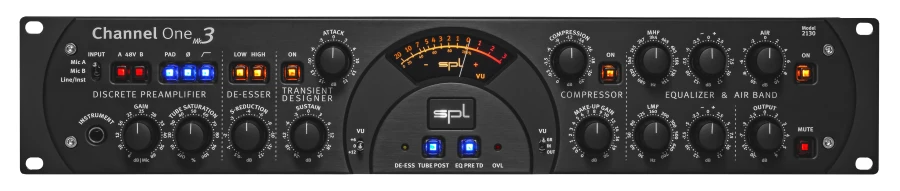
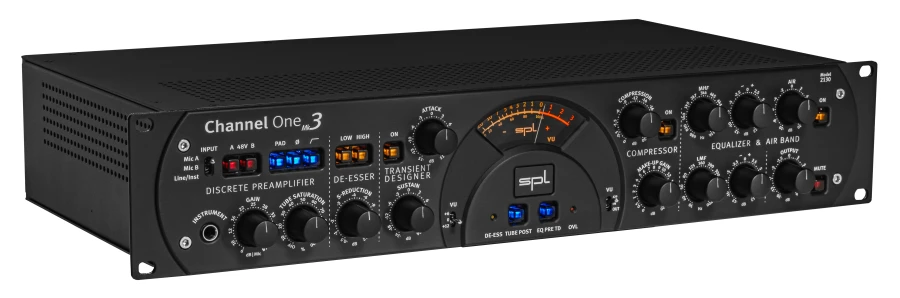
The SPL Channel One Mk3 is an analog channel strip that has been the benchmark for recording and mixing vocals and instruments for over twenty years. The third generation has been thoroughly redesigned: internal audio voltage increased to ±18 V for a more detailed sound, an improved preamp section, a tube saturation stage, an integrated Transient Designer, and direct comparison between two microphones. The de-esser, compressor, and equalizer remain on board, offering you all the tools of a true console channel in a single unit, whether you’re working with microphone, line, or instrument sources.
The discrete preamp offers up to +68 dB of gain on microphones, sufficient even for dynamic and low-output ribbon microphones. The line input covers -20 to +16 dB, while the instrument input covers -6 to +30 dB. The -20 dB PAD handles very loud sources such as percussion and brass; polarity reversal corrects phase issues on all inputs; and the 6 dB/octave high-pass filter reduces impact noise below 80 Hz.
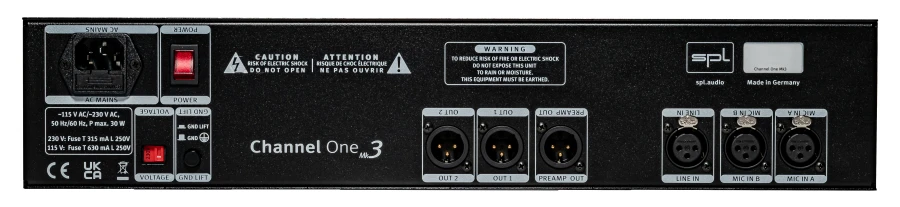
On the back panel, you’ll find two microphone inputs, Mic A and Mic B, each with its own 48 V phantom power that can be activated separately and features a delayed relay to prevent switching noise. You can connect a large-diaphragm condenser and a dynamic microphone, or a tube microphone and a ribbon microphone, and compare them in real time on the same source without unplugging any cables.
The high-impedance (1.1 MΩ) instrument input on the front panel accepts bass and electric guitar DI signals. The line input, on the other hand, lets you use the Channel One Mk3 as an insert in your DAW like a true analog plugin: you send a track from the interface, process it with saturation, a de-esser, a compressor, and EQ, and record it back.
The Preamp Out takes the signal immediately after the preamp, without any processing. By recording it on a separate track, you always have a clean copy of the take: if the compressor was pushed too hard or you wanted the saturation at a different point in the chain, you can send the track back into the Channel One Mk3 via the line input and reprocess it with the correct settings.
The saturation stage uses a true tube powered at 250 V. With a single knob, you can go from barely perceptible harmonics to expressive saturation, with a smooth signal compression comparable to that of tape; the output level is automatically compensated. The Tube Post button moves the saturation after the preamp, before the de-esser, or to the end of the chain after the EQ.
The Transient Designer acts on the signal’s envelope independently of the level, without a threshold. Use Attack to boost or cut the transient by up to 15 dB, and Sustain to lengthen or shorten the tail by up to 24 dB: ideal for adding punch to a snare drum, drying out an acoustic guitar, or controlling room reverb. The “EQ pre TD” button reverses the order between the equalizer and the Transient Designer.
The SPL de-esser is based not on compression but on phase cancellation: it automatically detects sibilants, inverts their phase, and adds them back to the original signal, leaving the rest of the spectrum intact. The Auto-Threshold feature maintains constant reduction even when the singer moves closer to or farther from the microphone, so you don’t have to adjust the settings during a take. You can activate the Low band at 6.4 kHz, the High band at 11.2 kHz, or both, and adjust the intensity with S-Reduction; an LED indicates each sibilant detected.
The compressor is controlled via the Compression knob, which sets the threshold between 0 and -20 dB, and the Make-Up Gain knob, which goes up to +20 dB. Attack and release times automatically adapt to the signal: faster for plosive consonants and sudden peaks, slower for sustained notes, ensuring transparent, uncolored dynamic control. The dual-VCA circuit, with one in-phase signal and one inverted signal summed in a differential amplifier, reduces distortion and offset noise, resulting in natural and dynamic vocals and instruments.
The EQ features two semi-parametric bands with proportional Q: LMF from 30 to 700 Hz and MHF from 680 Hz to 15 kHz, both with ±12 dB. With proportional Q, the bandwidth narrows as gain increases, so significant adjustments remain precise while subtle ones are broader and more musical. The Air filter—a bell-shaped coil-capacitor circuit centered at 19 kHz with ±10 dB—adds air and presence to vocals or softens harshness in the high frequencies.
The output control ranges from -20 to +6 dB to match the AD converter. The backlit VU meter displays either input level, output level, or gain reduction, with a scale adjustable to three reference points. The OVL LED monitors all critical points in the signal chain, from the preamp to the output, and a Mute button silences the outputs. The two parallel outputs allow the signal to be sent to two recorders without an external splitter.
4 mm black anodized aluminum front panel, machined aluminum knobs, powder-coated steel chassis, and Neutrik connectors with gold-plated contacts. Many key components are mounted with through-holes, allowing users to select parts based on sound quality.
SPL Channel One Mk3 Technical Specifications
Channels
1 (Mono)
Hardware format
Rack
€ 2.184,00 € 1.820,00 + VAT
 Normally shipped in 10-15 working days
Empty cart


