Synthesis and Synthesizers
Published on 13/04/2026



In the world of Eurorack modular synthesis, time is often managed through clocks, triggers and regular sequences. In contrast, the Make Noise GTE, an acronym for Gestural Time Extractor, introduces a much more organic approach, in which rhythm is not simply imposed on the patch, but emerges directly from signal behavior. It is this idea that makes GTE one of the most interesting modules for those working with generative patches, performative systems, and complex configurations within the Make Noise N.U.S.S. ecosystem.
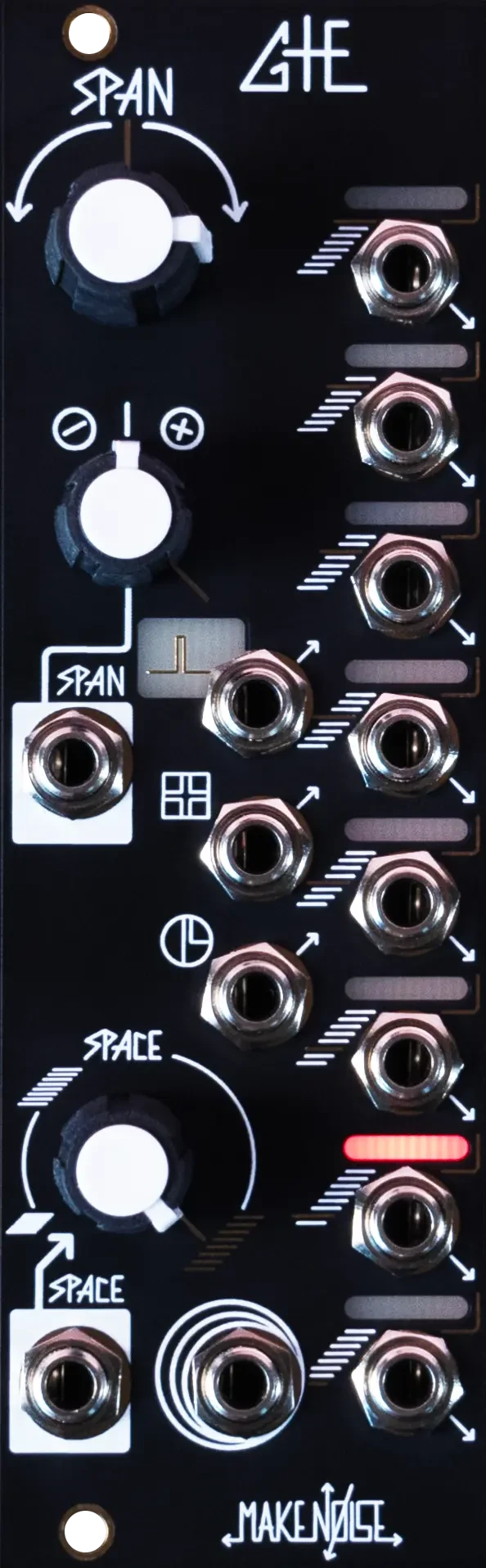
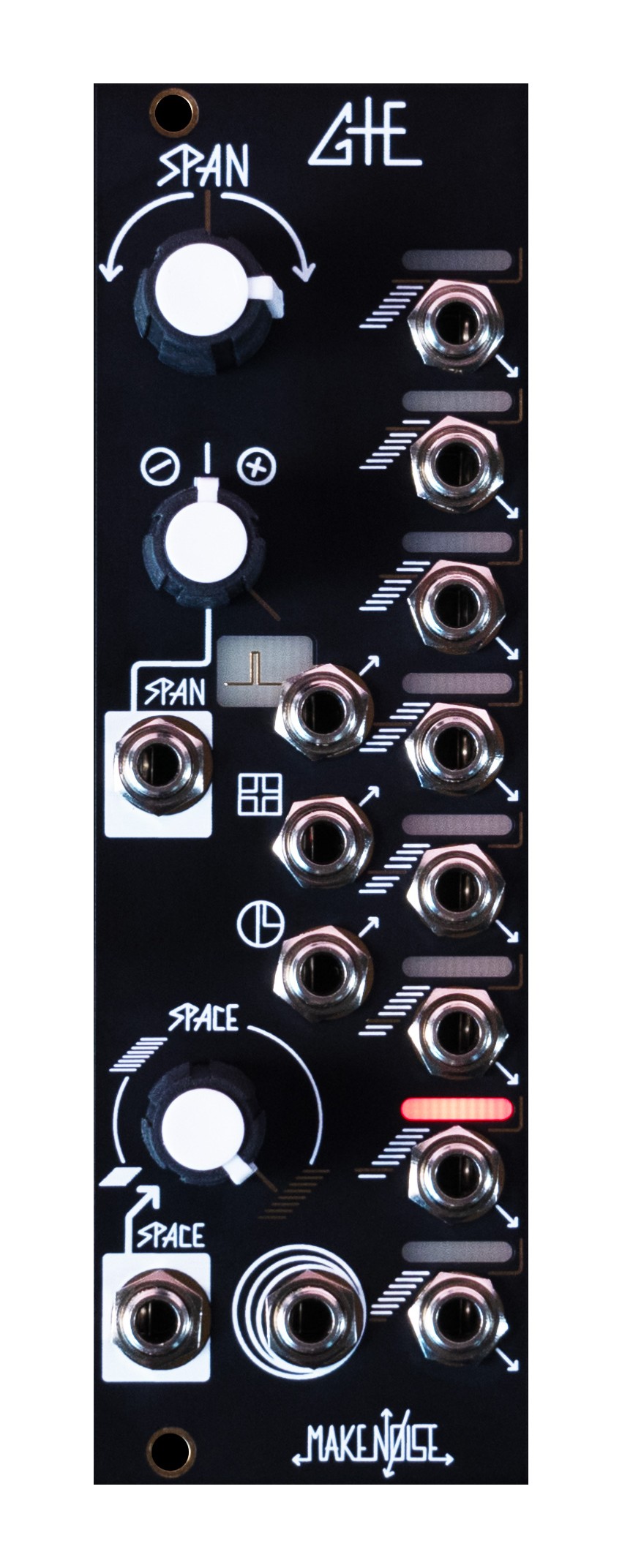
The GTE is an 8HP analog module designed to analyze the motion of the signal received at the Span input and convert it into usable timing information within the system. From this analysis it derives up to eight distinct channel pulses, a GTE pulse stream reflecting the speed of signal motion, and two gates dedicated to the even and odd channels. In practice, the Make Noise GTE allows clock, rhythm, and pulse streams to be obtained from any control source, opening up very different possibilities than those offered by a classic trigger generator.
This behavior makes it particularly effective for those who wish to build patches where tempo arises from sound, modulation, or electronic gesture, instead of depending solely on a rigid metric grid. In this sense, the GTE is perfectly in line with the philosophy of the New Universal Synthesizer System, where each module contributes to a network of dynamic relationships between control, triggering, and signal distribution.
Within the Make Noise N.U.S.S. system, the GTE finds a particularly strategic place because it not only generates rhythmic events, but can also behave as a Channel Index Translator. This means that it can read channel index signals from other modules in the system and derive accurate gates for each active channel. In terms of patch design, this is an extremely valuable function for those who work with multichannel architectures and wish to more precisely control the triggering of individual voices.
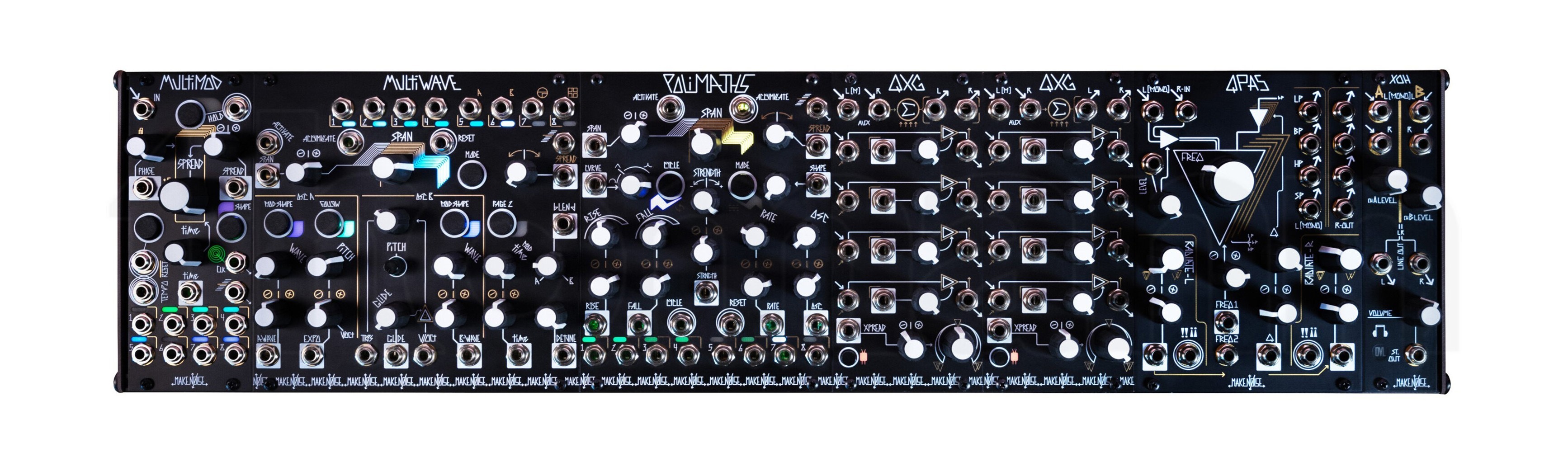
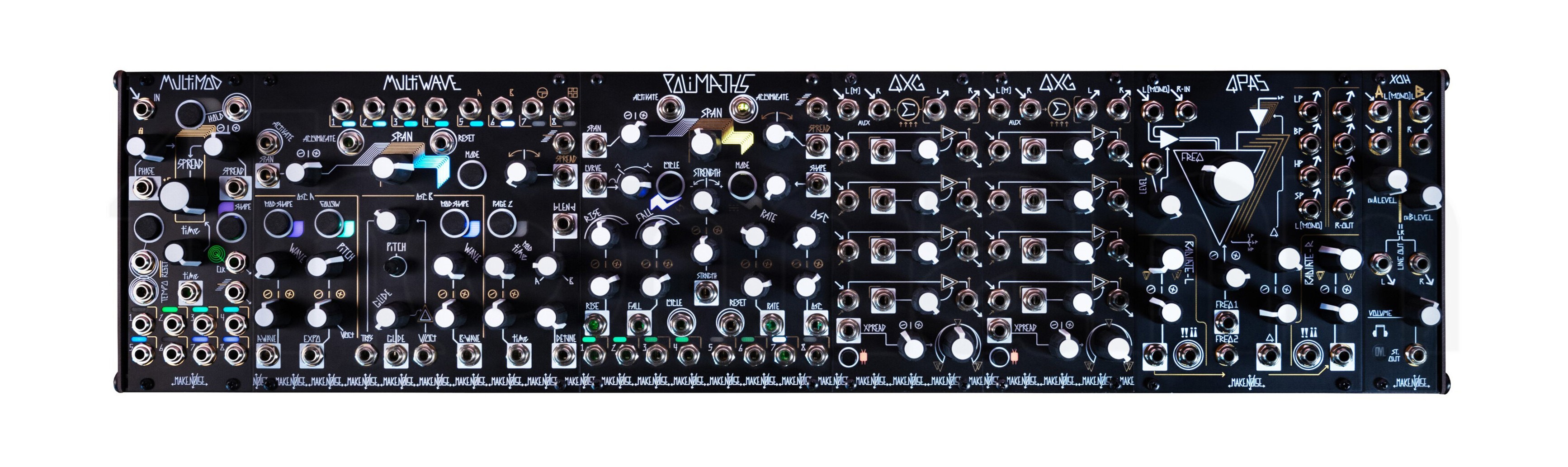
In an advanced configuration, the GTE dialogues naturally with PoliMATHS, which generates CV and audio events on eight channels, with MultiWAVE, which manages a multichannel wavetable engine, and with QXGs, which are essential for dynamic control and output articulation. Alongside these modules, MultiMod can also help create complex motions from which the GTE extracts new rhythmic information, while Jumbler further expands the ability to redistribute signal paths in variable and creative ways.
In a complete system, where QPAS for stereo filtering and XOH for final mix and outputs also find their place, the GTE thus becomes a bridge between modulation, rhythmic articulation, and temporal patch organization. The MultiWAVE MIDI Inlet, while having a different function, also contributes to the integration of the N.U.S.S. system, making the dialogue between external sources, MIDI control and multichannel management even more interesting.
One of the most important elements of Make Noise GTE is the Space control. This parameter determines the proximity of thresholds between channels and directly affects the sensitivity of the module, its responsiveness, and the density of events generated. At narrower settings, the GTE reacts very quickly to even small changes in the signal; at larger values, however, the behavior tends to be more stable, readable, and controllable.
youtube=["https://www.youtube.com/watch?v=P3U8G8zVHfQ"]
From a musical point of view, this translates into great versatility. A slow LFO, irregular modulation generated by MATHS or MultiMod, or channel activity from PoliMATHS can produce completely different patterns depending on how Space is set up. This is one reason why GTE is not just a utility, but a real compositional tool for modular synthesis.
Although its strong point is organic time extraction, the Make Noise GTE can be easily integrated into synchronized patches thanks to the Clock input. When this input is used, the output channel changes only when a gate or trigger is received, allowing GTE events to be synchronized with sequencers, drum machines, other Eurorack modules, or timing sources already in the system.
youtube="https://www.youtube.com/watch?v=Uf2N5616u5Q"]
This feature is particularly useful when you want to maintain the complexity and variability of GTE behavior, but without losing the control needed in live settings, structured recordings, or performance-oriented setups. In other words, the module can be as free and gestural as it is perfectly aligned with an external rhythmic infrastructure.
GTE expresses its full potential in patches where time is not just a medium, but an integral part of the sound language. In a system based on MultiWAVE, PoliMATHS, QXG, and MultiMod, it can become the center of rhythmic distribution, generating channel-specific pulses and fostering extremely musical management of activations. In a patch with Jumbler, it can help create complex variations in the relationships between signals and destinations, while in a setup with QPAS and XOH it helps structure a more articulate overall movement to the final system output.
It is equally effective in multi-voice systems, where the need to articulate each path independently becomes central. Here GTE allows temporal information to be derived from a single analog source and distributed in a controlled manner among multiple events, making it ideal for those who want polyrhythmic, dynamic and less predictable synthesis. For those who also use MATHS, the module also proves a natural companion for transforming functions, slope and modulations into a true living rhythmic infrastructure.
The real value of the Make Noise GTE lies in the fact that it changes the way we think about tempo in a modular system. Instead of starting with a clock and then building a patch, GTE allows you to start with the patch itself and let time emerge from its internal variations. This approach makes it particularly attractive not only to users of the N.U.S.S. system, but to anyone looking for a module capable of generating rhythms, clocks and pulse streams from CV signals in a controllable, creative and deeply musical way.
Compact, powerful and perfectly insertable into both Make Noise systems and any advanced Eurorack configuration, the GTE is an excellent choice for those who want to expand their rhythmic vocabulary. In combination with MultiWAVE, PoliMATHS, QXG, MultiMod, MultiWAVE MIDI Inlet, QPAS, XOH, Jumbler, and MATHS, it becomes a central node in the construction of evolutionary, expressive patches rich in temporal depth.
Related Products
€ 1.435,34 Ex VAT
 For European customers, select your country to view the correct price including VAT.

€ 153,94 Ex VAT
For European customers, select your country to view the correct price including VAT.
€ 2.039,15 Ex VAT
For European customers, select your country to view the correct price including VAT.
Join us today and get 5% off your next order!
Empty cart